Sell puts, get assigned, write calls — the trade stays open and the basis stays right.
Price any of 58 strategies on the real chain, then keep the campaign on one ledger. KO $90 put to 20 November was $0.89 at the 20 October close — $89 credit against $9,000.
Drag a strike on KO to start. Credit and collateral update as you drag.
Drag the strike, read the new credit
Every leg is a chip on the real strike ladder. Drag it and the credit, breakeven, chance of profit and net Greeks land on the same frame — the engine runs in your browser, so nothing waits on our server.
The link keeps what you paid
Legs live in the address bar and rewrite on every edit. Copy it and the link carries your entry premiums and the date you took them. Opened cold with no cookies it still reads: shared entry $370 credit, $89 to buy it back now, +$281 (+75.9%) since.
Open interest and IV on every strike
Each strike on the ladder carries its open interest, its implied volatility and its own Greeks, for every expiry the chain lists — the whole board, not a curated handful of strikes around the money.
Save it before you have an account
3 saved trades live in your browser from the first click, and move into your account the day you make one. Nothing you built gets thrown away in between.
Assignment
You sold a put on a stock you wanted anyway. It got assigned.
The share lot appears at the strike, the premium you already collected comes off the basis, and the cycle stays open — the put, the assignment, every covered call written after it, the dividends and the call-away all on one ledger with one number at the bottom.
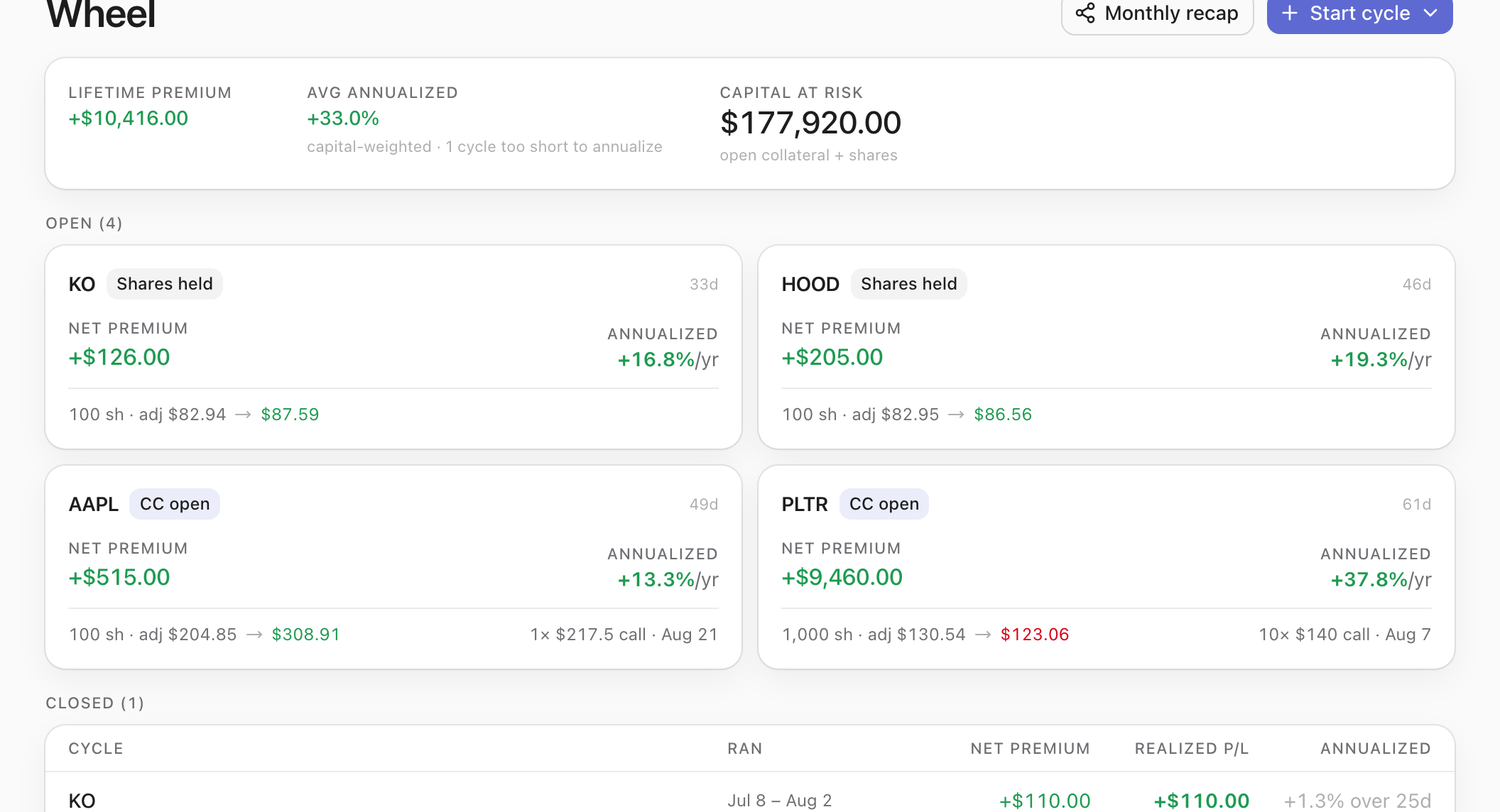
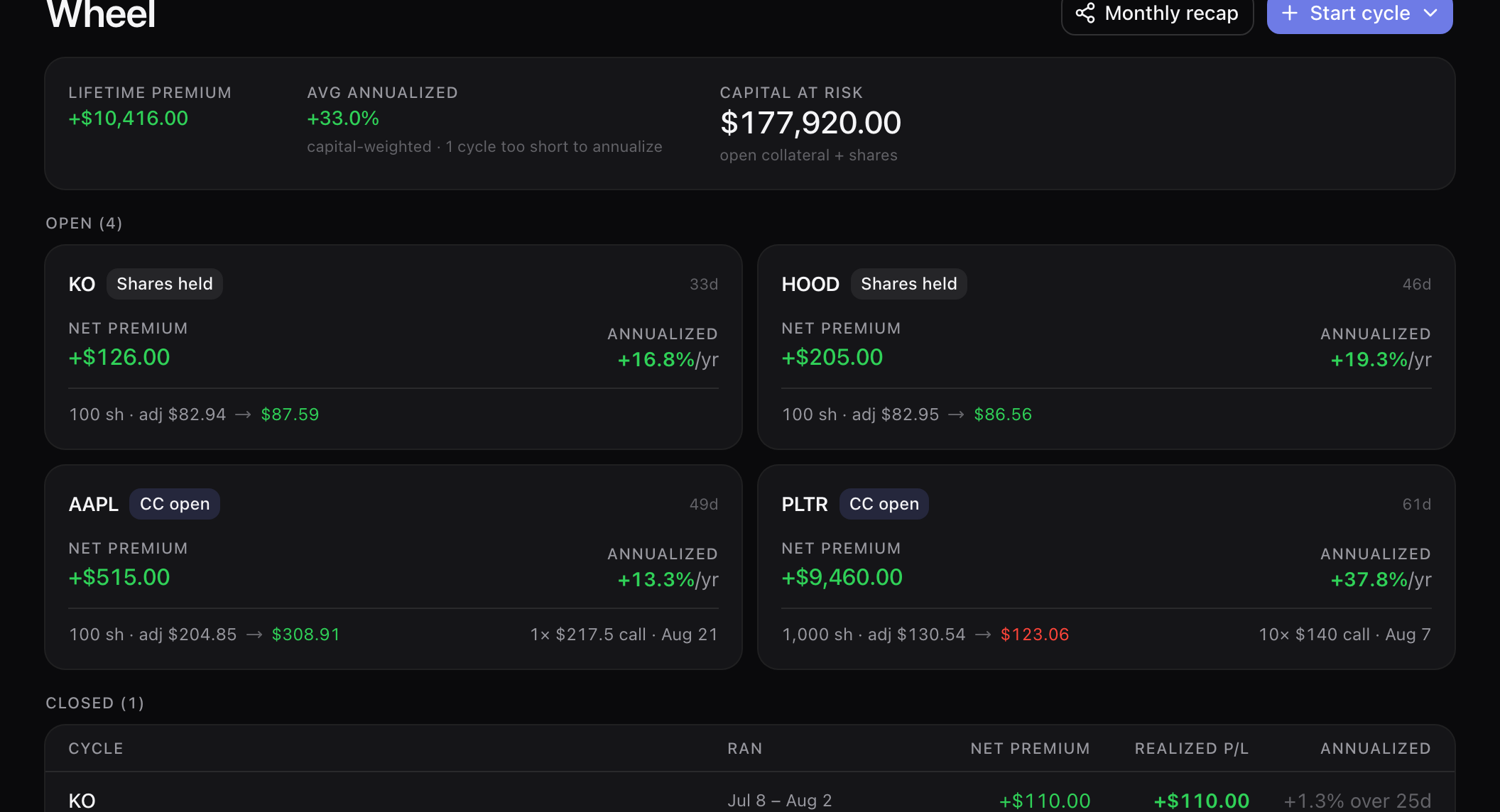
- HOOD: $85 put sold 18 June for $2.05, assigned 17 July. 100 shares at an $82.95 adjusted basis, +$205 banked against the $8,500 the assignment tied up, badged “Shares held” in the OPEN list, where assignment left it rather than closing it — with the put that produced it attached.
- AAPL: assigned at $210, then a $220 call that expired worthless and a $217.50 call still running. $515 banked, basis $204.85, and the yearly rate on the card is computed on the capital the cycle actually tied up rather than on the premium.
- PLTR: 1,000 shares assigned at $140 and $9,460 collected across three calls and a buy-back — the position reads $130.54 a share, not the $140 strike.
- Nothing auto-closes. A cycle ends when you close it or the shares leave, never because an option leg expired, was assigned or was bought back — and a partial assignment leaves the rest of the contracts live.
Expiry
The put expired worthless. It closed at $0.00.
Expiration, assignment and a closing trade are three different events with three different records, and none of them needs a price invented to make the books balance. A short that expired worthless is worth zero, and that is what goes in.
- A short put closed at zero keeps its whole credit. The KO cycle that sold an $86 put for $1.10 on 8 July and let it expire books +$110.00 realized against a $0.00 cost basis on the $8,600 it tied up — and because it ran 25 days the ledger states “+1.3% over 25d” instead of multiplying that by 365.
- Take KO's 20 November $90 put, $0.89 at the 20 October close: $89 of credit, and letting it expire worthless realizes all $89 rather than $88 after a penny you never paid.
- Close, assign or expire at any price the field accepts, $0.00 included, on a full position or on part of one.
- The bigger cost of a penny close is structural: a record that requires a closing price cannot represent an assignment at all, so the share lot and the basis behind it never happen.
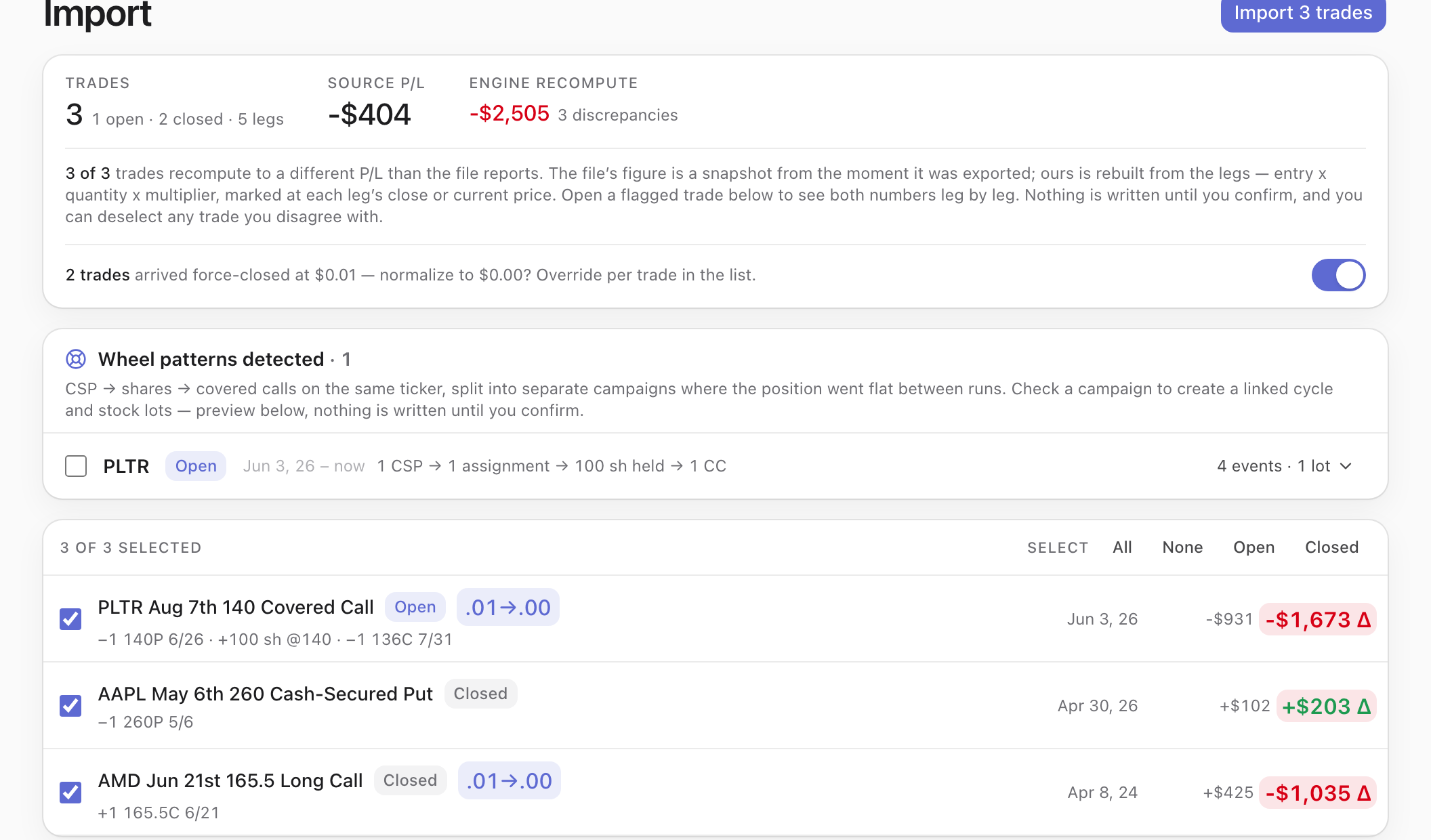
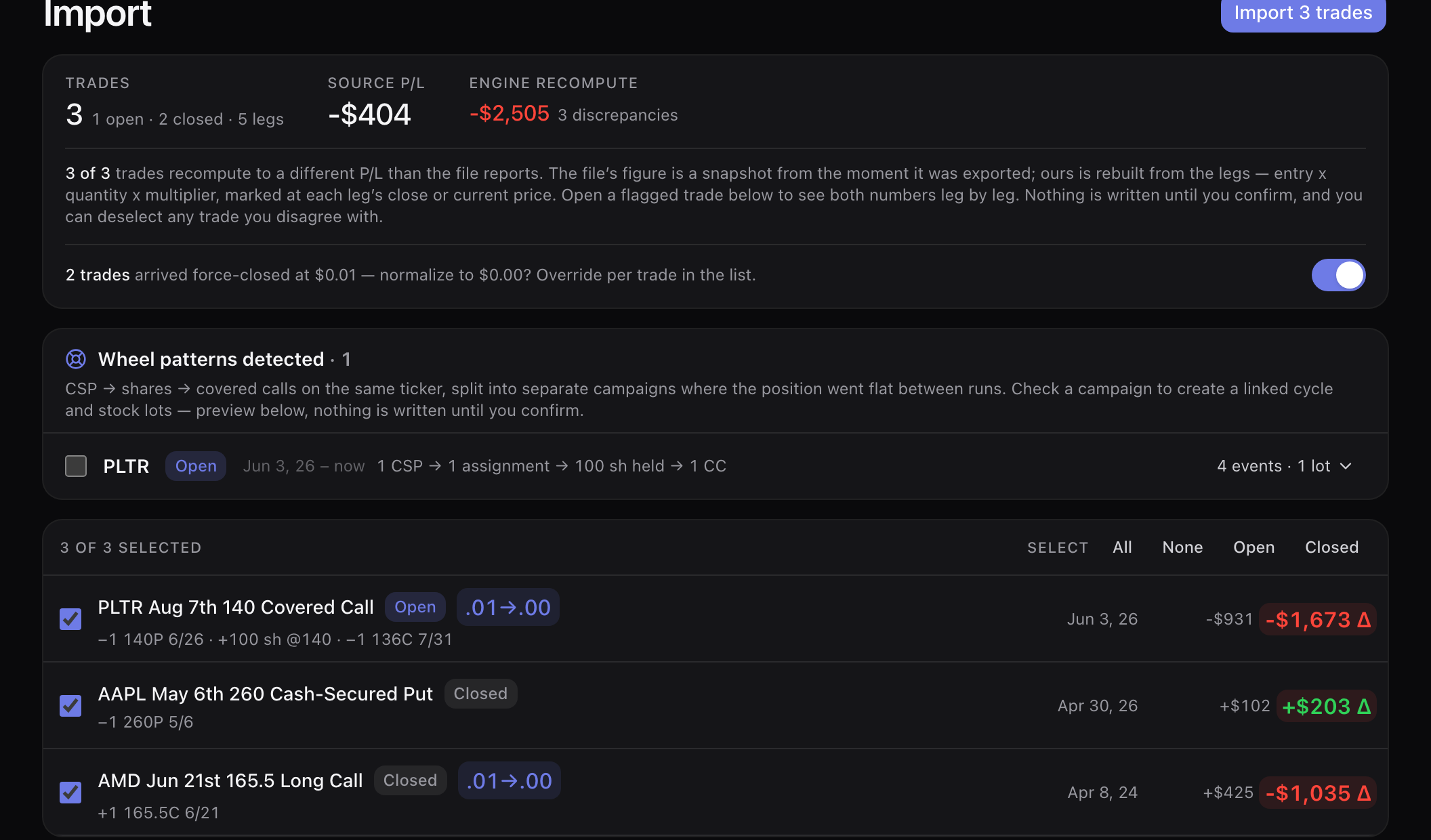
- Histories that arrive with every expired leg force-closed at $0.01 are flagged on import, normalized to zero in one tap, and overridable per trade if you genuinely did pay a penny to get out.
Moving in
Every trade you have made so far is in a spreadsheet and a brokerage screen.
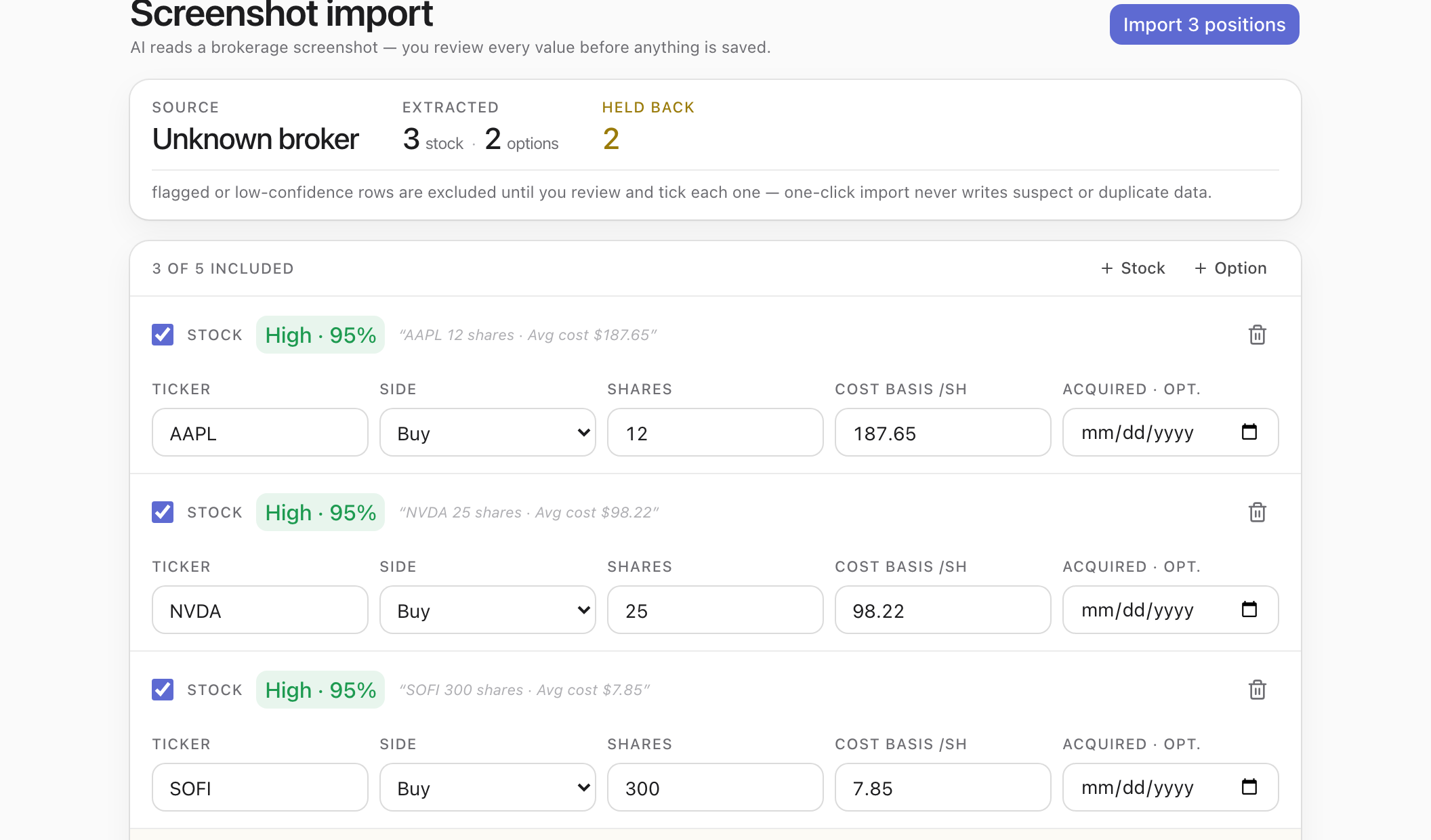
Upload the history file and every trade comes back as a trade — legs, dates, entry and close — with our recompute next to the source's number and the differences flagged. Screenshot your positions screen for whatever the file reader cannot take. Nothing is written until you confirm it.
- One spreadsheet layout, .xlsx or .csv: a row per trade with its legs beneath it, historical and active together, duplicate-safe on re-import — the FAQ lists the exact columns. A brokerage's own positions file is a different shape, and that history comes in through the screenshot reader instead.
- A put, an assignment and covered calls on the same ticker are rebuilt as one linked cycle with its stock lot — four events and a 100-share holding folded into one position, instead of four loose tickets nobody can add up.
- Penny closes flagged and normalized to $0.00 in one tap, overridable per trade.
- Brokerage screenshots read by AI vision — thinkorswim, Schwab, Robinhood, Fidelity — with a confidence score per row and the low-confidence ones held back until you tick them. That path is Pro; the file import is free and stays free, because getting your history in should not have a price.
Copilot
“Sell me a 28-delta cash-secured put on KO, about 30 days out.”
Ask that with no account and no session and you land in the builder with real legs off the real chain, priced. Building, quoting and explaining are free all the way down to an anonymous visitor. What Pro buys is the copilot working on your own book: reading your cycles and lots, logging an assignment, closing a leg, costing the next roll.
- Free, logged out included: ticker search, quotes, the chain, all 58 templates, analysis of the legs already on your screen, and how-do-I answers that walk you to the right screen instead of describing it.
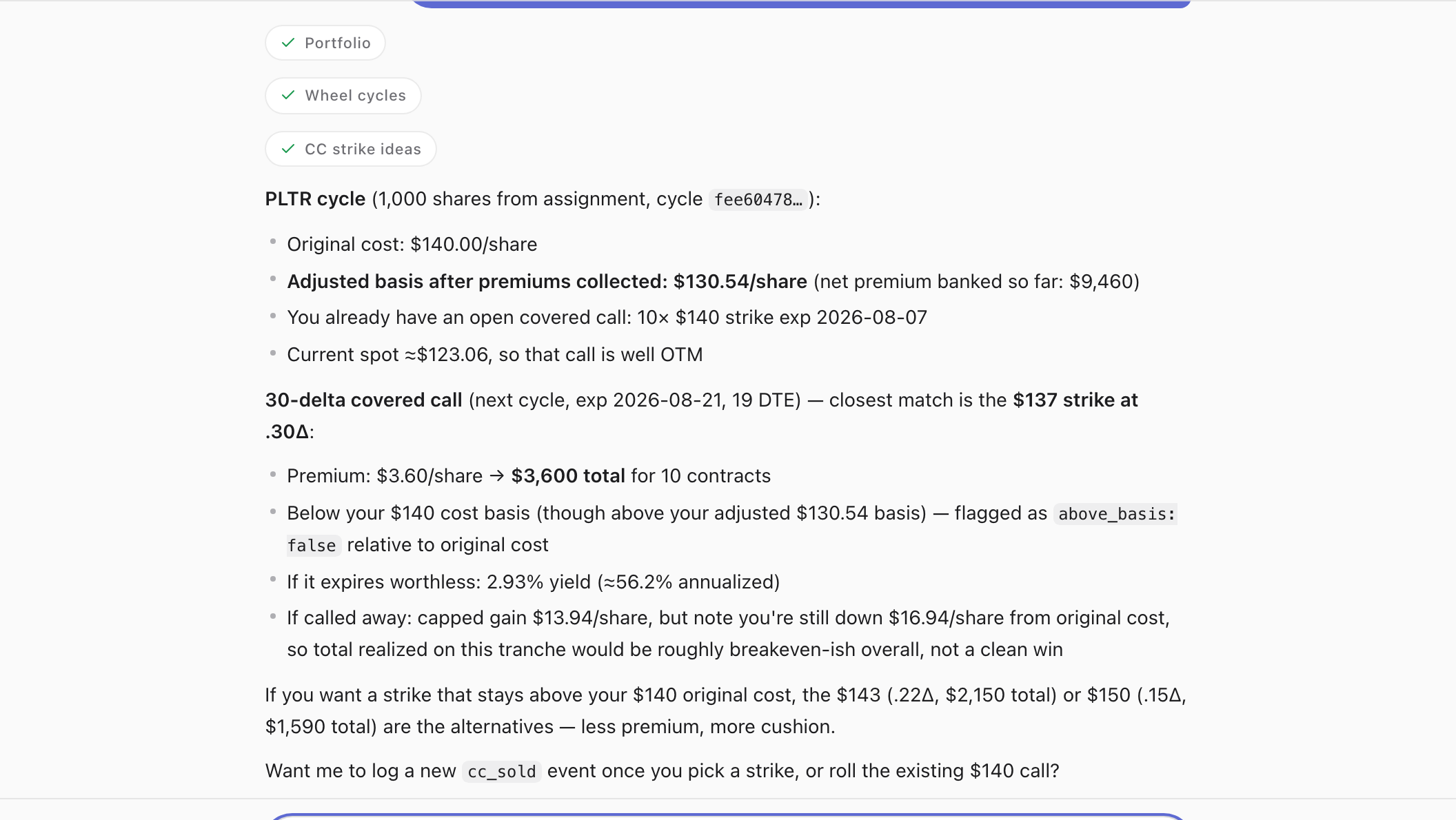
- Pro: your saved trades, portfolio, wheel cycles, alerts and watchlists — “what's my adjusted basis on PLTR?” answers $130.54 against the $140 assignment and lays out the strike table for the next call.
- Every write is a preview you approve first: logging an assignment, closing a leg, creating a cycle. The tool calls are on screen, so you can see which of your tables it read before it answered.
- At the paid boundary it says so in one line — “I can build it — saving and tracking it with me is Pro.” — and hands back the working builder URL with it, so the trade you asked for still arrives.
Free covers the builder, the real chain and the wheel tracker
58 templates on the real chain, Greeks, chance of profit, the strike ladder, share links that pin your entry — all of it with no account at all. A free account adds the wheel and portfolio trackers, watchlists, alerts, the optimizer and the file importer, still $0 and still no card, and holds 3 saved trades. Pro adds the copilot on your own positions, the brokerage-screenshot importer and unlimited saves. Pro is $29 a month or $290 a year — two months free on annual — and every new account starts with 14 days of it, no card.
Writing
Five worked examples, priced off real chains
A full PLTR wheel cycle folded end to end, six MSFT put strikes ranked by annualized return and by the tail they open, covered calls on shares bought years ago, and what a $0.01 close does to a year of records. Every number computed by the same engine that prices the builder.
- Strategy guideCovered call assignment: getting called awayGetting called away is not a glitch. You sold 100 shares at the strike the day you wrote the call. Here is that sale on a real AAPL chain, with the premium still attached.7 min read
- Strategy guideEarly assignment and the ex-dividend dateEx-dividend week, short calls, panic. On a real KO chain the remaining extrinsic is larger than the dividend the engine implies over the whole window. Here is that comparison, and when early assignment actually shows up.7 min read
- Strategy guideCovered call vs selling the shares: real mathEvery covered-call seller has been asked why they don't just sell the stock. Fair question. One ticker, one chain, both exits priced — including the Friday the call does exactly what you sold it to do.7 min read
- Strategy guideOption assignment: what actually happensNew put sellers treat assignment like a penalty. It is a fill: you buy 100 shares at the strike, your basis is strike minus the credit, and the next trade starts there. Here is that fill, priced.7 min read
- Strategy guideThe wheel strategy, with real numbersEveryone can recite the four steps. Almost nobody can tell you what a completed cycle returned on the capital it tied up. Here is one, priced off a real chain and folded by the same engine that runs our tracker.12 min read
- Strategy guideRolling options: when it works, when it doesn’tEvery wheel trader rolls, and almost nobody prices what the roll actually did. Here are three rolls with the arithmetic shown: a covered call up and out for a real credit, a tested put defended at a real cost, and the sequence of rolls that quietly gave the whole premium stack back.10 min read
- Strategy guideCash-secured put vs buying the stock: real mathEvery put seller has heard it: why not just buy the stock? It is a fair question with a computable answer. One ticker, one chain, both trades priced side by side — including the scenario where the put seller regrets everything.7 min read
- Tax mechanicsHow the wheel is taxed: premium, basis, timingThe wheel's economics are one number; its tax treatment is four different events with four different dates. Here is a full cycle refolded the way a 1099 reads it — premium into basis, worthless expiries as gains, holding periods that stop and start — with the arithmetic shown.8 min read
- Strategy guideWhat a cash-secured put actually paysThe annualized-return column is the one everybody screenshots. It is also the one that tells you least. Here is the whole ladder — return, probability, breakeven, and the loss that takes six winners to repair.9 min read
- Strategy guideCovered calls on shares you already ownThe covered-call math you find online divides premium by cost basis. If you bought the stock years ago, that number is a fantasy — and it will talk you into selling a strike you should never have touched.9 min read
- MechanicsStrike selection with delta and IV"Sell the 30 delta" is the most repeated rule in retail options and nobody can tell you what it means. Here is what delta actually measures, where it stops matching probability, and how far off it gets on a high-IV name.10 min read
- OpinionWhy closing at $0.01 is wrongRecording an expired option as a close at $0.01 costs almost nothing in dollars. What it does to assignment history, cost basis and your recorded win rate is a $599 hole in the middle of a wheel — here is the arithmetic.10 min read
Put a strike ladder on a ticker you actually trade.
Open it, price it, keep it. Save when you want to — 3 saves live in your browser and move into an account the day you make one.